
Guide
How Deaf People Call Customer Service and Contact Businesses
Relay services, captioned calls, video relay, and the text and online options businesses already offer, explained by task instead of by regulation.

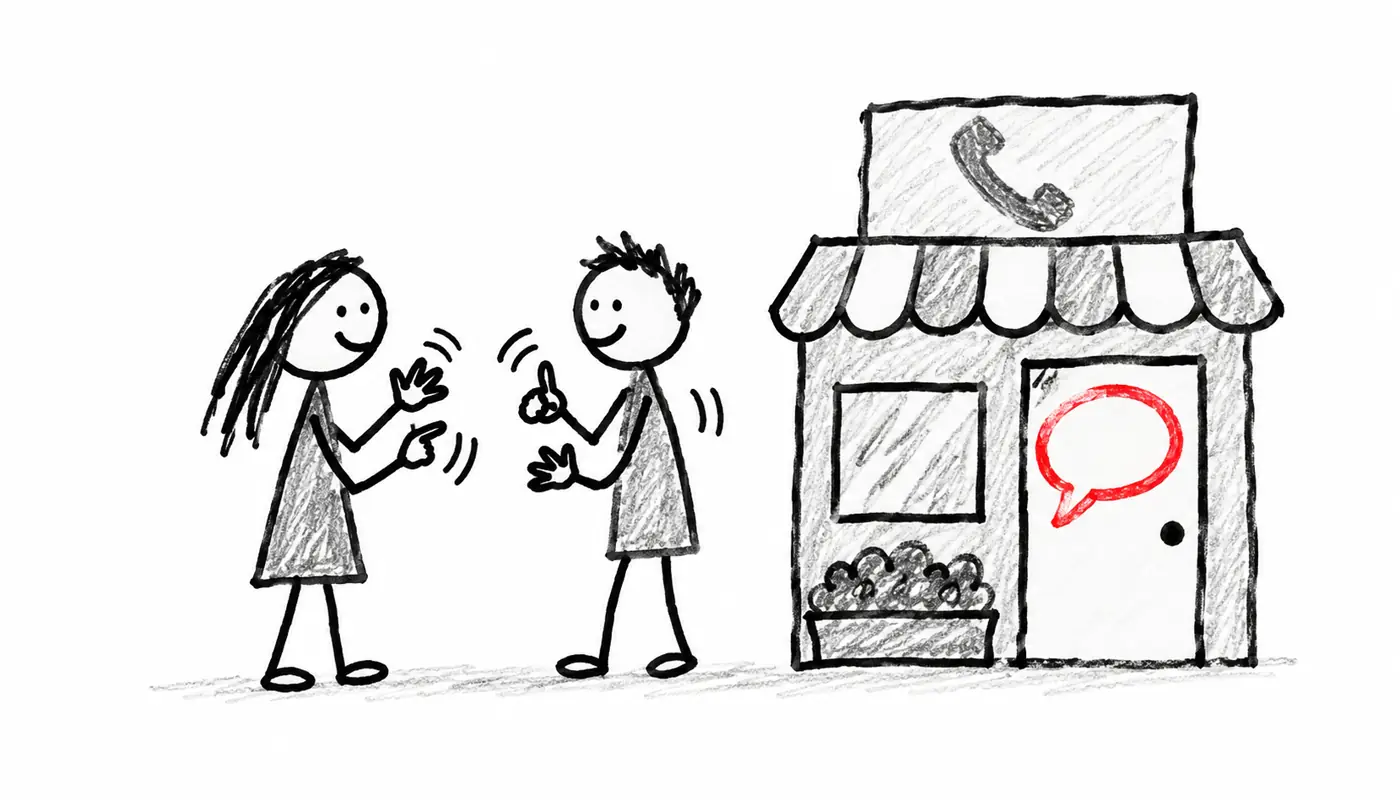
Deaf and hard of hearing people reach customer service through relay: typed, captioned or signed calls, all free in the US. Or they skip the call with chat, text or email.
Fastest way:
- Type your side: dial 711 from a TTY
- Talk and read: open a captioned-call app
- Sign in ASL: open a video relay app
- Emergency? Contact 911 directly, not through 711.
- Type your call with 711 or an app
- Talk and read captions if you have some hearing
- Sign with an interpreter if ASL is your language
- Use Canadian relay if you’re in Canada
- Get help in an emergency with 911 or text 911
- Skip the call with chat, text, email or booking
- Ask Reqly for a quick fact from a small business
How deaf people call customer service with relay
Relay is free and works in every state. A trained assistant or interpreter passes your words along in real time. You lead the call, and it stays confidential.
711 doesn’t reach video relay, IP Relay or captioned calls (FCC). Start those from the provider’s app, device or website.
1. Type your call: dial 711
- Dial 711 from your TTY (a text telephone).
- Give the assistant the business’s number.
- Type your side. The assistant speaks it and types back the replies.
Want to speak for yourself and read the replies? Ask for Voice Carry Over.
No TTY? Text relay over the internet (IP Relay) works from a phone app or browser. Fewer providers offer it. Check the FCC’s provider list.
2. Talk and read captions
Captioned calls (IP CTS) are for people who can speak and have some hearing. You talk to the business and read captions of what they say.
- Install a captioned-call app from a listed provider and sign up.
- Dial the business from the app.
- Talk as usual and read the captions.
Prefer a desk phone? A captioned telephone (CTS) shows captions on a built-in screen.
3. Sign with an interpreter
Video relay (VRS) lets you sign in American Sign Language with an interpreter over video. The interpreter voices your words and signs back the replies.
- Open your video relay app or videophone.
- Enter the business’s number.
- Sign to the interpreter.
Your provider gives you a ten-digit number so businesses can call you back.
4. Use Canadian relay
Canada runs its own relay services:
- Video relay: SRV Canada VRS, in ASL or LSQ (Quebec Sign Language), at no cost.
- Text relay over the internet (IP Relay): through your phone provider, for home and cell phones.
- TTY relay: for home phones.
5. In an emergency
- Contact 911 directly. The FCC advises TTY users to call 911 directly, not through 711.
- In many US areas you can text 911. If it’s not available, you’ll get a bounce-back message.
- In Canada, Text with 9-1-1 (T9-1-1) works once you register with your wireless provider.
6. Skip the call: chat, text, email or booking
- Website or app chat: many retailers, banks, airlines and utilities have a chat bubble.
- Text lines: check the Contact page or website footer. See can you text a business?
- Email and contact forms: slower, but you get a written record.
- Online booking: look for a Book button on the website or Google Maps or Apple Maps listing. Doctors often use a patient portal (a secure site for messages and visits). See doctor appointments without calling.
- In person: a typed note on your phone screen works well at a counter.
Copy this into an email or contact form:
Subject: Question from a customer (please reply in writing)

Hi, I don't use voice calls.
Please reply by text or email at ____________.
My question: ____________________
Name: ____________
Order or account number (if any): ____________
Best times to reach me: ____________
Thank you!
7. When there’s no online option
Some small businesses have no chat, booking page or email reply. For a quick fact, like walk-ins or stock, Reqly asks the place for you and texts you back the answer. Reqly is not a relay service and not a replacement for one. For back-and-forth or account questions, use relay or the business’s own channels. Here’s what that looks like:
Do you take walk-ins today for a manicure?
Later
Yes, walk-ins until 5 pm today. Mornings are usually quieter.
via Reqly agent
To start, share a place to Reqly from Apple Maps, Google Maps or Yelp, or type your question.
See Reqly in 30 seconds
Frequently asked questions
How do deaf people call customer service?
Many use a free relay service, where an assistant or interpreter relays the call by text, captions or sign language. Others skip the phone and use a business's chat, text, email or online booking.
Does 711 connect to video relay or IP Relay?
No. According to the FCC, 711 does not reach video relay, IP Relay or captioned calls. You start those from the provider's app, device or website.
Do relay services cost anything to use?
In the US, relay calls are free to users and providers are paid from state or federal funds. In Canada, SRV Canada VRS is offered at no cost.
What is the difference between captioned calls and video relay?
Captioned calls are for people who speak and have some hearing: you talk and read captions. Video relay is for people who use American Sign Language and sign with an interpreter over video.
What should I do in an emergency?
Contact 911 directly. The FCC advises TTY users to call 911 directly rather than through 711. In many US areas you can text 911, and in Canada T9-1-1 works once you register with your wireless provider.